Palm Springs · Hotels
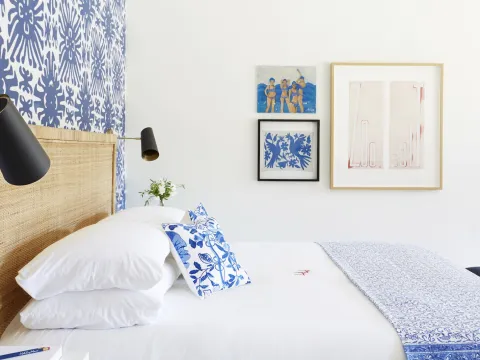
Holiday House Palm Springs
What convinced us is the pedigree: Holiday House was designed in 1951 by Herbert W....
La Serena Villas opened in 1933 as a private residence before architect May Sung reunited three adjoining residential parcels into a single compound, built in the Spanish-eclectic style that defines much of pre-war Palm Springs. The result, restored rather than reinvented, is eighteen individual bungalows arranged around courtyards and garden paths, each one carrying its own front door, its own patio, and enough separation from its neighbors that the compound reads as a small village rather than a hotel. The blue-trimmed windows and bronzed ironwork hardware that mark the original construction have been kept rather than replaced, and the landscaping follows the same restraint: citrus trees, bougainvillea, and gravel paths rather than manicured lawns laid down for show.
We chose La Serena Villas for the rare case where a restoration adds rather than erases: every bungalow keeps the compound's 1930s architectural language of exposed beams, tiled accents and arched doorways, while the systems underneath, plumbing, wiring, climate control, have been brought fully up to date. The fire pit and the claw-foot tub on every patio are not retrofits borrowed from a design catalog; they extend a layout the original architect intended guests to use outdoors as much as in, which keeps the compound feeling lived-in rather than staged for photographs, and it holds up to actual daily use rather than just a first impression.
The compound sits inside Palm Springs' Tennis Club neighborhood, the oldest residential district in the city and one built, as its name suggests, around the courts that once drew Hollywood regulars for winter stays. Downtown's Palm Canyon Drive is a short walk rather than a drive, and Spencer's Restaurant, a Tennis Club fixture since the 1950s, sits close enough to reach on foot for dinner. The San Jacinto Mountains rise directly behind the property, close enough that the rooftop views feel immediate rather than scenic-overlook distant, and the neighborhood's quiet residential streets make the short walk back from downtown part of the appeal rather than an inconvenience.
Price range: Luxe
Vibe: Spanish-eclectic, romantic, garden-led
Rooms: 18 bungalows
Best for: couples wanting a historic, architecture-led romantic stay
Our favorite thing about the hotel: a private fire pit and a claw-foot tub on every single patio
Dining: Azucar, the on-site Mediterranean tapas restaurant, open Friday through Sunday
Amenities: private pool with its own massage pavilion, central courtyard, on-site wedding venue
Nearby attractions: the Tennis Club neighborhood, Spencer's Restaurant, San Jacinto Mountain views
Each of the eighteen bungalows was designed, and has been restored, around the idea that guests should want to spend time outside their own front door rather than only inside it. The fire pits sit on private patios rather than in a shared lounge area, and the tubs are original claw-foot fixtures rather than a modern silhouette dressed up to look vintage. Evenings in Palm Springs cool quickly once the sun drops behind the mountains, which makes the fire pits more than decorative: they are used, and the compound's layout, with each bungalow set apart from its neighbors by garden paths and citrus trees, means a patio evening stays private rather than overlooked by the next villa.
Azucar, the property's on-site restaurant, serves Mediterranean-leaning tapas from a rooftop deck open Friday through Sunday, with the San Jacinto range as a backdrop rather than a skyline of other buildings. The pool itself comes with a dedicated massage pavilion, a detail that sets it apart from a standard poolside cabana setup, and the central courtyard doubles as a wedding venue on weekends when the compound is not fully booked for individual stays. It is this combination, architecture-led restoration, outdoor-first bungalow design, and a small number of shared spaces used deliberately rather than constantly, that keeps La Serena Villas feeling like a private compound rather than a resort wearing a historic facade.
What convinced us is the pedigree: Holiday House was designed in 1951 by Herbert W....
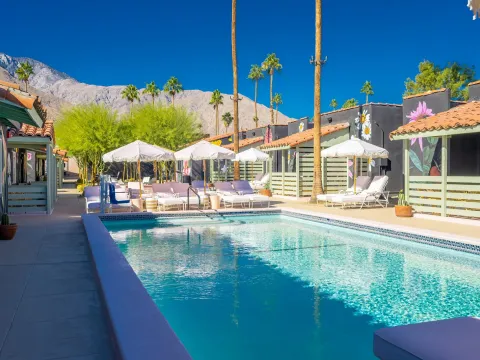
We were drawn to the story behind the name: the owners took Fleur Noire from...
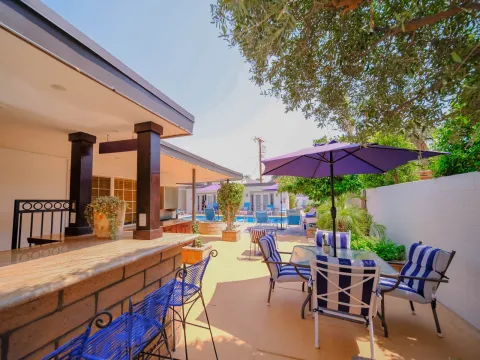
We chose this address because it still carries the spirit of the ranch it was...